
For the past few years, much of the AI debate has focused on model capability. In enterprise settings, however, results increasingly depend on the system around the model. What information the model can access, how that information is retrieved, and whether it can be trusted has become vital.
Technologies such as the Model Context Protocol (MCP) make organisational information more accessible to AI models, but they also make weaknesses in that data harder to ignore and more consequential.
In simple terms, MCP is an open protocol that gives AI applications a consistent way to connect to external tools and data sources. Rather than limiting an AI application to the information contained in a prompt, MCP allows it to retrieve information, interact with business applications and carry out approved actions as part of its workflow. In practice, an MCP-enabled application can:
Read files, database records and other resources exposed by an authorised MCP server.
Call tools and APIs made available to it.
Retrieve or refresh relevant context during a task.
Carry out approved actions in connected systems.

Enterprise platforms are adopting the same approach. Salesforce offers hosted MCP capabilities that allow authorised AI assistants to access Salesforce data and invoke Agentforce agents or prompt templates. Informatica’s MCP servers can expose data-management functions such as metadata search and data-quality scoring. In both cases, MCP standardises access to enterprise capabilities, but unfortunately, it does not guarantee that the information behind them is accurate or properly governed.
MCP and RAG play different but complementary roles. MCP gives an AI application a standard way to access external tools and information. RAG determines which information should be retrieved and supplied to the model as context. Even a well-designed MCP-enabled system using graph-based RAG remains constrained by the quality of its source information.
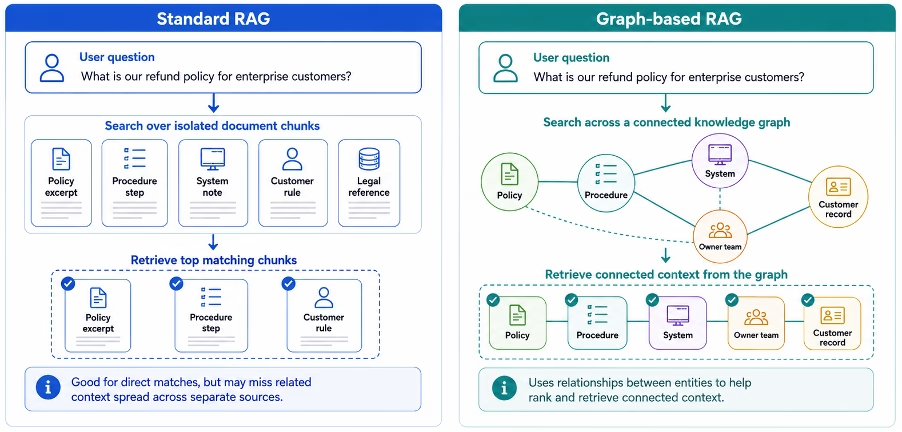
Where questions depend on relationships across people, policies, systems or records, graph-based RAG can add further structure. Rather than retrieving only semantically similar passages, it can also surface connected entities and documents. This is particularly useful for relationship-heavy questions, although building and maintaining the graph introduces additional complexity.
This is particularly valuable within a company’s knowledge base, where information is rarely stored in a single document. Instead, it is spread across policies, procedures, applications and historical records that all relate to one another. Graph RAG helps the model navigate those relationships instead of treating each document in isolation.
A conventional search may retrieve the correct policy but miss the procedure it superseded, the application in which it is implemented, or the team responsible for keeping it current. Graph-based retrieval can surface those connections alongside the original document.
These technologies improve access to information. But they do not, by themselves, make that information accurate. If authoritative sources are outdated, contradictory, incomplete or poorly owned, the system may simply retrieve the wrong answer more efficiently.
Whether the model is accessing documentation, customer records, product information or internal policies, the information it retrieves must be accurate, consistent and well maintained. Poor quality data leads to poor quality retrieval, giving the model incomplete or misleading context and increasing the likelihood of errors. An MCP enabled system with Graph RAG can only ever be as effective as the information it is built upon.
Even then, source quality is only one part of reliability. Indexing, retrieval design, entity resolution, permissions, evaluation and monitoring also influence which information reaches the model and how it is used.
In Moffatt v Air Canada, a 2024 British Columbia Civil Resolution Tribunal small-claims decision, an Air Canada chatbot told a customer that a bereavement fare could be requested within 90 days after travel. Another page on the same website said that retroactive requests were not permitted. The tribunal found that Air Canada had not taken reasonable care to ensure its chatbot was accurate and held the company responsible for the misleading information.
The case is best understood not as a proven example of an LLM hallucination, but as a failure of information consistency and governance. Customers encountered two contradictory versions of the same policy, with no reliable way to know which one was authoritative.
An AI assistant working across Salesforce might use MCP to connect to CRM records and approved actions, while RAG retrieves relevant customer, product and policy context. Informatica can help integrate, cleanse and govern the underlying data, but then if those sources are duplicated, incomplete or contradictory, the assistant may still retrieve and act on the wrong information.
AI is only as good as its foundations, even when enhanced by MCP and RAG. The error may appear in the model’s answer, but its cause can sit anywhere in the chain: the source record, the retrieval process, the permissions applied to it, or the way the model interprets the retrieved context. So, a customer may leave unhappy, or a salesperson may be unable to complete a sale.
This is why data quality is now an AI delivery challenge as well as a data-management challenge. As organisations adopt MCP-enabled systems and increasingly sophisticated retrieval techniques, the differentiator will not simply be which model they choose. It will be the quality, governance, and organisation of the data that powers it. The most capable AI systems will belong not to the organisations with the largest models, but to those with the most trustworthy information.
Preparing to connect Agentforce or another AI to your operational data? The first step is understanding whether that information is accurate, structured, and properly governed. Get in touch with Cloud Perspective at info@cloudperspective.co.uk
